How Often Should Commercial Garage Doors Be Serviced?
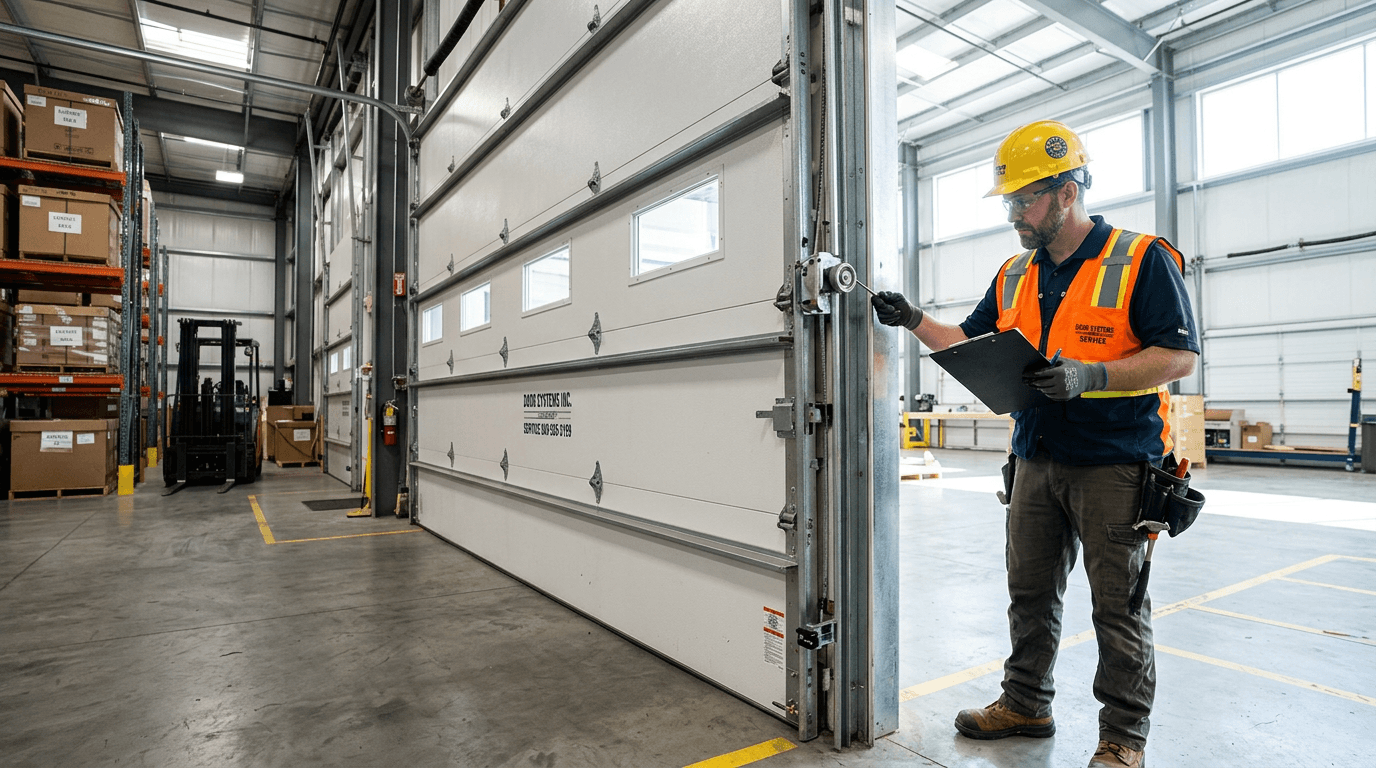
"How often should we service our doors?" It's one of the most common questions facility managers ask—and the answer isn't one-size-fits-all. The right service interval depends on how many times your doors cycle each day, your operating environment, door type, and how critical that door is to your operations.
Get the frequency wrong in either direction and you're either wasting money on unnecessary visits or setting yourself up for a breakdown that costs ten times more than the service would have.
Here's how to determine the right service schedule for your commercial garage doors.
The Short Answer
For most commercial facilities, the baseline recommendation is:
- Professional service: At least twice per year (every 6 months)
- Staff visual inspections: Monthly
- Lubrication: Quarterly
But that baseline only applies to standard-use doors in moderate environments. Many commercial doors need more frequent attention.
Factors That Determine Service Frequency
1. Daily Cycle Count
This is the single biggest factor. Every time a door opens and closes counts as one cycle. More cycles mean faster wear on every component—springs, rollers, cables, hinges, opener motors, and tracks.
Low use (under 10 cycles/day):
- Storage facilities, seldom-used bays, secondary entrances
- Service every 6-12 months
- Springs may last 5-7+ years
Moderate use (10-25 cycles/day):
- General warehouses, retail receiving areas, manufacturing support bays
- Service every 6 months
- Springs typically last 3-5 years
High use (25-50 cycles/day):
- Distribution centers, busy loading docks, production floor access points
- Service every 3-4 months
- Springs may last 1-3 years
Extreme use (50+ cycles/day):
- Logistics hubs, cold storage with frequent truck traffic, automated production lines
- Service every 2-3 months or on a continuous maintenance contract
- Consider high-cycle springs rated for 50,000-100,000 cycles
If you don't know your door's cycle count, many modern commercial openers have built-in cycle counters. For older systems, estimate by tracking how many times the door opens during a typical shift, then multiply by operating days.
2. Operating Environment
Florida's climate puts extra stress on commercial doors. Environmental factors that increase service frequency:
Coastal locations (salt air exposure):
- Salt accelerates corrosion on springs, tracks, hardware, and cables
- Add 1-2 extra service visits per year
- Lubricate every 2 months instead of quarterly
High humidity (all of Florida):
- Promotes rust on unprotected metal components
- Condensation inside tracks and spring assemblies causes hidden corrosion
- Quarterly service minimum
Extreme temperatures / direct sun exposure:
- Heat expands metal components, affecting alignment and spring tension
- UV degrades rubber seals and plastic rollers faster
- Weather seals should be checked at every service visit
Dusty or debris-heavy environments:
- Construction sites, agricultural operations, woodworking shops
- Debris clogs tracks, grinds rollers, and contaminates lubricant
- Clean and lubricate every 1-2 months
Chemical exposure:
- Manufacturing plants, automotive facilities, food processing
- Chemical vapors corrode metal and degrade lubricants faster
- Service every 3 months with corrosion-resistant lubricants
3. Door Type
Different door types have different service demands:
Sectional doors:
- More moving parts (hinges, rollers, cables, pulleys)
- Roller replacement is a common maintenance item
- Service every 6 months for standard use; quarterly for high use
Roll-up / coiling doors:
- Fewer moving parts but the coiling mechanism needs attention
- Curtain guides and barrel bearings are primary wear points
- Service every 6 months; quarterly for high-cycle applications
High-speed doors:
- Designed for extreme cycle counts but have specialized components
- Sensors, safety systems, and door curtains need regular inspection
- Service every 3-4 months minimum
Fire-rated doors:
- Required to be inspected and tested annually per NFPA 80
- Functional testing must be documented for code compliance
- Annual professional inspection is the legal minimum; semi-annual is recommended
For a deeper comparison of door types, see our guide on roll-up vs sectional doors.
4. Door Age
Older doors need more frequent service:
- Under 5 years: Follow manufacturer's recommended schedule (typically semi-annual)
- 5-10 years: Increase to quarterly inspections; components are entering their wear phase
- 10-15 years: Quarterly service with proactive part replacement; start budgeting for major component replacements (springs, opener)
- Over 15 years: Consider whether increased repair frequency justifies door replacement
Recommended Service Schedule by Facility Type
| Facility Type | Typical Cycles/Day | Recommended Service | Notes |
|---|---|---|---|
| Office/retail (back entrance) | 5-10 | Every 12 months | Low priority |
| General warehouse | 10-20 | Every 6 months | Standard schedule |
| Manufacturing plant | 15-30 | Every 4-6 months | Chemical/dust exposure may increase |
| Distribution center | 30-50+ | Every 3-4 months | High cycle count is the driver |
| Cold storage facility | 20-40 | Every 3 months | Seal integrity is critical |
| Food processing | 15-30 | Every 3 months | Hygiene + chemical exposure |
| Auto dealership/service | 15-25 | Every 6 months | Standard with weather seal focus |
| Fire station | 10-20 | Every 6 months | Reliability is mission-critical |
| Airport/hangar | 5-15 | Every 6 months | Large door size increases component stress |
What Happens During a Professional Service Visit
A proper commercial door service visit should cover:
Inspection:
- Visual check of all panels, tracks, hardware, springs, cables, and seals
- Operational test through full open/close cycles
- Balance test (door should hold at mid-height when disconnected from opener)
- Safety system test (auto-reverse, photo-eyes, entrapment protection)
Maintenance:
- Lubrication of all moving parts (rollers, hinges, springs, bearings, locks)
- Track cleaning and debris removal
- Hardware tightening (bolts, brackets, mounting points)
- Weather seal inspection and adjustment
Assessment:
- Component wear evaluation with remaining life estimates
- Identification of parts approaching end of life
- Recommendations for proactive replacement vs. next-visit monitoring
- Written report documenting findings and actions taken
For a detailed breakdown of what to check, see our commercial garage door maintenance checklist.
What Your Staff Should Do Between Professional Visits
Professional service doesn't replace daily awareness. Train your team to:
Monthly:
- Walk each door and look for visible damage, rust, or loose hardware
- Listen during operation for new or worsening noises
- Check that the door opens and closes fully without hesitation
- Report anything unusual immediately
Quarterly:
- Apply lubricant to rollers, hinges, and spring coils
- Clear debris from tracks
- Test the safety reversal system
Anytime:
- Never ignore a door that's making new sounds, moving slowly, or hanging unevenly
- Stop using a door immediately if you hear a loud bang (likely a broken spring) or see frayed cables
Know the warning signs that demand immediate repair.
The Cost of Under-Servicing vs. Over-Servicing
Under-servicing is far more expensive:
- A skipped $300 service visit can lead to a $1,500-3,000 spring replacement
- Worn rollers that cost $15 each to replace can damage $2,000+ worth of track
- A failed opener motor ($2,000-5,000) often starts as a $200 capacitor issue
- Unplanned downtime costs vary but can reach thousands per hour for busy facilities
Over-servicing wastes money but doesn't cause harm:
- An extra service visit costs $200-400
- If your doors are in great shape, the tech confirms it and you have documentation
When in doubt, err on the side of more frequent service. The cost difference between "a bit too often" and "not often enough" is dramatic.
Set It and Forget It: Planned Maintenance Programs
The easiest way to stay on schedule is to take scheduling off your plate entirely. Our Planned Maintenance Program provides:
- Customized service frequency based on your doors, usage, and environment
- Scheduled visits with reminders—no tracking required on your end
- Complete inspection, lubrication, and adjustment at every visit
- Detailed reports with photos documenting door condition over time
- Priority scheduling if a repair is needed between visits
- Consistent pricing with no surprise charges
Get on the Right Schedule
Every facility is different, and the right service frequency depends on your specific situation. If you're unsure whether your current maintenance schedule is adequate—or if you don't have one at all—we can help.
Contact Paratec today for a free assessment of your commercial doors. We'll evaluate your doors, usage patterns, and environment, then recommend the right service schedule to keep everything running safely and reliably.