Top 5 Signs Your Commercial Garage Door Needs Immediate Repair
A commercial garage door that's starting to fail doesn't always announce itself with a dramatic crash. More often, the signs are subtle—a strange noise here, a slow response there. But ignoring these early warnings can turn a minor repair into a major emergency that shuts down your operations and puts employees at risk.
Knowing what to look for gives you the chance to schedule repairs on your terms instead of dealing with a crisis. Here are the top 5 signs your commercial garage door needs immediate attention.
1. The Door Is Making Unusual Noises
Every commercial door makes some sound during operation, but new or worsening noises are a clear warning sign.
What to listen for:
- Grinding or scraping — Metal-on-metal contact usually means worn rollers, damaged tracks, or misaligned components. Left unchecked, this damages multiple parts at once.
- Loud banging or popping — This can indicate a spring or cable issue. If you hear a sudden loud bang, a spring may have already snapped—stop using the door immediately.
- Squealing or squeaking — Dry bearings, hinges, or rollers need lubrication at minimum, but persistent squealing after lubrication points to worn-out parts.
- Rattling or vibrating — Loose hardware, worn brackets, or a failing opener motor.
Why it matters: Unusual noises almost always get worse, not better. What starts as a minor roller issue can escalate into track damage, panel warping, or a complete door failure. Early intervention saves money.
If your door is making sounds it shouldn't, our commercial garage door repair team can diagnose the issue quickly.
2. The Door Responds Slowly or Hesitates
A commercial garage door should open and close smoothly and consistently. When it doesn't, something is wrong.
Warning signs:
- Delayed response after pressing the open/close button
- Door pauses mid-cycle before continuing
- Slower than usual travel speed
- Inconsistent operation — works fine sometimes, struggles other times
Common causes:
- Worn springs — Springs lose tension over time and can't counterbalance the door's weight properly. The opener motor compensates by working harder, which slows operation and burns out the motor faster.
- Opener motor issues — Aging motors, failing capacitors, or worn gears reduce power output. See our opener troubleshooting guide for more details.
- Track problems — Bent tracks, debris buildup, or worn rollers create friction that slows door movement.
- Electrical issues — Loose wiring, corroded connections, or failing circuit boards cause intermittent delays.
Why it matters: A slow door in a busy warehouse or distribution center creates bottlenecks. More importantly, a door that hesitates could be one cycle away from getting stuck open—leaving your facility unsecured—or crashing closed unexpectedly.
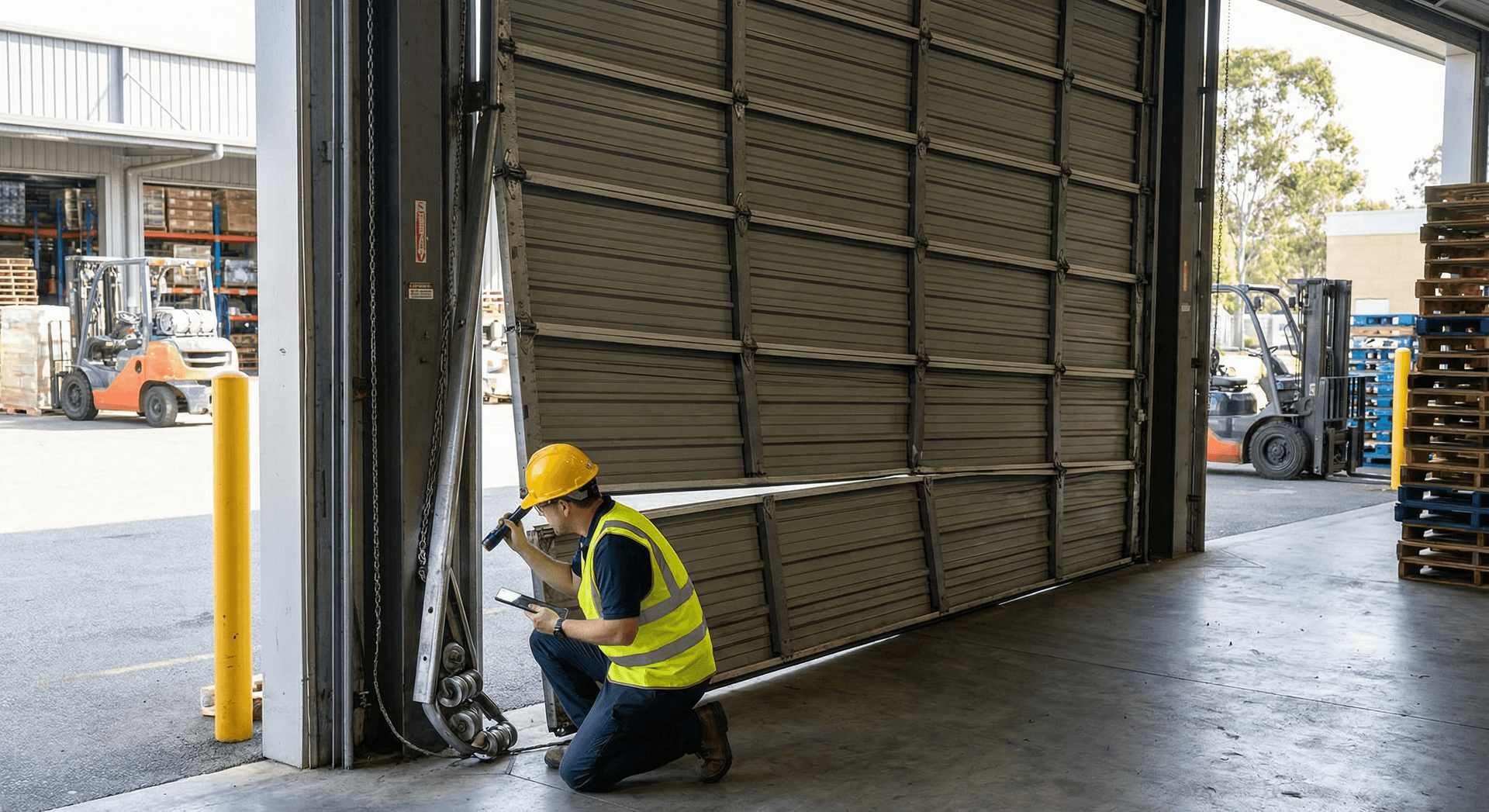
3. The Door Is Visibly Off-Track or Uneven
If your commercial door looks crooked, hangs at an angle, or has visible gaps when closed, you need repair now—not next week.
What to look for:
- One side hangs lower than the other
- Gaps along the bottom when the door is closed
- Door wobbles or sways during operation
- Visible gap between rollers and tracks
- Daylight showing around the door edges
What's happening:
- Cable failure — If one cable has snapped or slipped off the drum, the door loses support on one side. This is a serious safety concern that needs immediate attention.
- Spring imbalance — Uneven spring tension pulls one side faster than the other.
- Track misalignment — Impact damage from forklifts or vehicles can knock tracks out of alignment.
- Worn rollers — Rollers that have lost their shape can't track properly.
Why it matters: An off-track door is a safety hazard. It can fall unexpectedly, jam in place, or come completely off the tracks. It also compromises your building's security and climate control. Do not attempt to operate an off-track door—call a professional.
Contact our emergency garage door repair team if your door is off-track.
4. The Door Won't Fully Open or Close
A door that stops short—either not opening completely or not closing all the way—has a problem that needs immediate diagnosis.
Not opening fully:
- Broken or weakened springs can't lift the door's full weight
- Opener limit settings may be incorrect
- Track obstructions or damaged sections block travel
- Motor doesn't have enough power (failing motor or stripped gears)
Not closing fully:
- Safety sensors may be misaligned or blocked — see our guide on aligning garage door sensors
- Close limit settings need adjustment
- Broken or damaged bottom seal creating resistance
- Warped panels preventing full closure
- Spring tension issues causing the door to bounce back
Why it matters:
- Security risk — A door that doesn't close fully is an open invitation. Even a few inches of gap can be a liability.
- Energy costs — In Florida's heat, even a partially open dock door forces your HVAC system to work overtime.
- Pest entry — Gaps let in insects, rodents, and debris.
- Compliance issues — Temperature-controlled facilities may fall out of regulatory compliance if doors don't seal properly.
5. You Can See Physical Damage to the Door
Sometimes the signs are right in front of you. Physical damage to panels, hardware, or structural components demands prompt repair.
Types of damage to watch for:
- Dented or bent panels — Common from forklift impacts or loading accidents. Even minor dents can affect the door's ability to travel smoothly and seal properly.
- Cracked or broken panels — Compromised structural integrity that will worsen with every cycle.
- Rust and corrosion — Especially common in Florida's humid climate and coastal areas. Rust weakens metal components and spreads quickly once it starts.
- Damaged weather seals — Torn or missing seals along the bottom and sides.
- Bent or damaged tracks — Visible bowing, dents, or separation from the wall.
- Fraying cables — Visible strand separation is a warning that the cable is close to failure.
Why it matters: Physical damage rarely stays contained. A dented panel puts stress on adjacent panels and the track system. A rusted spring loses strength exponentially. The longer you wait, the more components are affected, and the more expensive the repair becomes.
For spring-specific concerns, visit our garage door spring repair page.
What Happens When You Ignore These Signs
We understand that scheduling repairs means coordinating downtime. But here's what happens when warning signs go unaddressed:
Short term (days to weeks):
- Problem worsens
- Connected components start to fail
- Door operation becomes unreliable
Medium term (weeks to months):
- Secondary damage accumulates (tracks, panels, opener)
- Repair costs multiply as more parts need replacement
- Safety risk increases significantly
Long term (months):
- Complete door failure
- Emergency replacement needed at premium cost
- Potential injury or property damage liability
- Extended operational downtime
A repair that might have cost a few hundred dollars can turn into a several-thousand-dollar replacement when ignored.
When to Call for Immediate Repair
Call a professional right away if:
- You hear a loud bang (likely a broken spring)
- The door is off-track or hanging unevenly
- Cables are visibly frayed or broken
- The door crashed down or won't stay open
- You see sparking or smell burning from the opener
- The door won't close and your facility is unsecured
Our team provides 24/7 emergency repair across Florida for exactly these situations.
Preventing Emergency Repairs
The best repair is the one you never need. Regular maintenance catches these warning signs early:
- Monthly visual inspections — Walk your facility and look at each door for damage, unusual gaps, or rust
- Listen during operation — Note any new sounds and report them
- Test door balance quarterly — Disconnect the opener and manually lift the door halfway. It should stay in place.
- Schedule professional inspections — At least annually, more for high-use doors
Our Planned Maintenance Program provides scheduled inspections, lubrication, adjustments, and early detection of failing components before they become emergencies.
Take Action Now
If you've recognized any of these 5 signs in your commercial garage doors, don't wait for the problem to get worse. Early repair is always faster, cheaper, and safer than emergency replacement.
Need a repair or inspection? Contact Paratec today for fast, reliable commercial garage door repair throughout Florida. We'll get your doors—and your business—back on track.