Roll-Up vs Sectional Doors: Which Is Right for Your Warehouse?
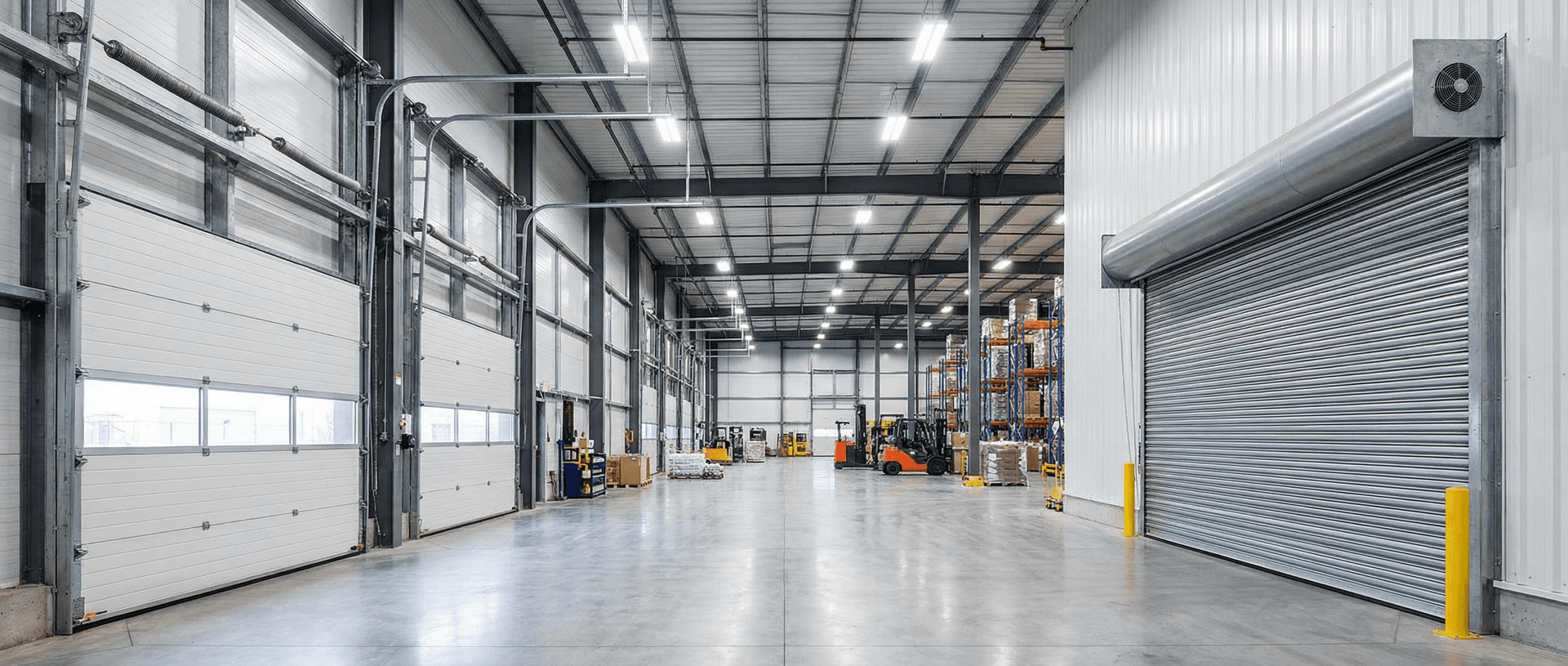
When it's time to install or replace garage doors in your warehouse, the choice usually comes down to two options: roll-up doors or sectional doors. Both are widely used in commercial and industrial settings, but they work very differently—and the right choice depends on your specific operation, space constraints, and budget.
This guide breaks down the differences, advantages, and trade-offs so you can make an informed decision for your warehouse.
How Each Door Type Works
Roll-Up Doors
Roll-up doors (also called rolling steel doors or coiling doors) are made of narrow interlocking steel slats that coil around a barrel assembly above the opening. When the door opens, the slats wrap tightly around the drum, storing the entire door in a compact coil above the doorway.
Mechanism: The door rolls up into a coil (similar to a window blind) housed in a hood or barrel at the top of the opening.
Sectional Doors
Sectional doors are made of wider horizontal panels (typically 18-24 inches tall) connected by hinges. When the door opens, the panels travel along a vertical track, curve through a radius, and slide along horizontal tracks that run parallel to the ceiling.
Mechanism: Panels articulate through a track system and stack horizontally under the ceiling when open.
Size and Space Comparison
This is often the deciding factor for warehouse applications.
Headroom Requirements
Roll-up doors require minimal headroom—typically just 12-18 inches above the opening for the coil assembly. This is a major advantage in warehouses with low ceilings, overhead obstructions, or mezzanine levels close to the door.
Sectional doors need significantly more overhead space. You'll need at least 12-18 inches of headroom plus the height of the door itself for the horizontal tracks. A 14-foot-tall sectional door might need 16+ feet of clear ceiling space behind the opening.
Side Room
Roll-up doors need minimal side room—just enough for the guide rails, typically 4-6 inches on each side.
Sectional doors need slightly more side room for the vertical track, typically 4-8 inches. The difference is usually negligible.
Back Room (Ceiling Depth)
Roll-up doors need almost no ceiling depth since the door coils above the opening. This leaves the full ceiling area free for lighting, sprinklers, HVAC, or storage.
Sectional doors extend back into the building along the ceiling when open. A 14-foot-tall door extends roughly 14-15 feet back from the opening. This can interfere with overhead cranes, ceiling-mounted equipment, racking near the door, or elevated conveyors.
Winner for space efficiency: Roll-up doors. If headroom or ceiling depth is limited, roll-ups are often the only practical option.
Durability and Maintenance
Roll-Up Door Durability
- Steel slats are individually replaceable if damaged—you don't need to replace the entire door for a single dented slat
- Fewer moving parts at the panel level (no hinges between sections)
- Coiling mechanism is the primary wear point; the barrel, springs, and curtain guides need regular attention
- Wind resistance is generally excellent due to the continuous interlocking slat design
- Typical lifespan: 15-25+ years with proper maintenance
Common maintenance needs:
- Spring tension adjustment and eventual replacement
- Curtain guide lubrication
- Slat replacement for damaged sections
- Barrel and bearing service
Sectional Door Durability
- Panels are thicker and more rigid than roll-up slats, offering better impact resistance for individual strikes
- More moving parts — hinges, rollers, cables, pulleys, and track joints all need maintenance
- Panel replacement is possible but more complex than slat replacement
- Better insulation options due to thicker panel construction
- Typical lifespan: 15-25+ years with proper maintenance
Common maintenance needs:
- Roller replacement (a frequent wear item)
- Hinge inspection and replacement
- Cable and drum service
- Track alignment
- Spring service
- Panel replacement for damaged sections
For general maintenance guidance, see our commercial garage door maintenance checklist.
Winner for maintenance simplicity: Roll-up doors. Fewer moving parts mean fewer things to maintain and replace. However, when roll-up components do fail, specialized service may be needed.
Insulation and Energy Efficiency
This matters significantly in Florida, where keeping heat out of a warehouse can dramatically affect energy costs and worker comfort.
Roll-Up Door Insulation
- Standard roll-up doors have minimal insulation. The thin interlocking slats don't leave much room for insulation material.
- Insulated roll-up models are available with foam-filled slats, but R-values are typically lower than sectional doors—usually R-4 to R-8.
- Air infiltration can be higher due to the many joints between slats.
Sectional Door Insulation
- Sectional panels are available with polyurethane or polystyrene insulation, achieving R-values of R-8 to R-18+.
- Thicker panels (2-3 inches) provide significantly better thermal performance.
- Fewer joints per square foot means less potential for air leakage.
- Better weather seal options — sectional doors typically offer superior perimeter sealing.
Winner for insulation: Sectional doors. If your warehouse is climate-controlled, stores temperature-sensitive goods, or you want to reduce cooling costs in Florida's heat, sectional doors are the better choice. For more on insulated options, check our guide on insulated commercial garage doors.
Security
Both door types provide solid security, but there are differences.
Roll-Up Door Security
- Continuous curtain — No gaps between slats when closed, making prying difficult
- Bottom bar locking — Standard slide locks or motorized locks secure the bottom rail
- Tamper resistance — The coiling mechanism makes it difficult to lift manually from outside
- Options: Cylinder locks, electric locks, chain-operated locks
Sectional Door Security
- Panel rigidity — Thicker panels are harder to force through
- Multiple locking points — Can be secured with locks at various positions along the track
- Opener security — Electric openers with rolling code technology prevent signal interception
- More vulnerable to prying — The gap between panels can be leveraged to force the door
Winner for security: Tie. Both types offer excellent security when properly installed and locked. Roll-ups have a slight edge against prying; sectionals have a slight edge in panel strength.
Cost Comparison
Initial Purchase and Installation
Roll-up doors generally cost more upfront for equivalent sizes. The coiling mechanism, barrel assembly, and specialized installation drive higher initial costs.
- Small (8x8 to 10x10): $1,500-4,000
- Medium (12x12 to 14x14): $3,000-7,000
- Large (16x16+): $5,000-15,000+
Sectional doors typically have lower upfront costs, especially for standard sizes where components are widely available.
- Small (8x8 to 10x10): $1,000-3,000
- Medium (12x12 to 14x14): $2,000-5,000
- Large (16x16+): $4,000-12,000+
Note: Prices vary significantly based on material, insulation, wind rating, and installation complexity.
Long-Term Cost of Ownership
The upfront price difference often narrows over time:
- Roll-ups may have lower maintenance costs due to fewer moving parts
- Sectionals may have lower energy costs if insulated models are used
- Parts availability is generally better for sectional doors
- Repair frequency tends to be similar with proper maintenance
Winner for cost: Sectional doors for upfront cost; roughly even for total cost of ownership. Your specific usage pattern will determine which is more economical long-term.
Cycle Speed and Frequency
How often your doors open and close affects which type is better suited.
Standard Operation
- Roll-up doors: 8-12 inches per second (standard motor)
- Sectional doors: 6-10 inches per second (standard motor)
High-Traffic Applications
For warehouses with frequent door cycles (30+ per day), consider:
- High-speed roll-up doors can operate at 24-48+ inches per second—dramatically reducing open time, energy loss, and workflow bottlenecks
- High-speed sectional doors exist but are less common and typically slower than high-speed roll-ups
Winner for high-traffic use: Roll-up doors. High-speed roll-up options are more widely available and achieve faster speeds. If your warehouse moves a lot of truck or forklift traffic through door openings, this is a significant factor.
Which Door Type Is Best for Your Warehouse?
Choose Roll-Up Doors When:
- Headroom is limited — Low ceilings or overhead obstructions
- Ceiling space is valuable — Overhead cranes, racking, or equipment needs clearance
- High cycle count — Multiple door cycles per day benefit from roll-up durability
- Speed matters — High-speed roll-up options are faster
- Space is tight — Roll-ups take up the least overall space
- Multiple doors in a row — Compact design fits more doors in a given wall space
Choose Sectional Doors When:
- Insulation is important — Climate-controlled facilities need the higher R-values
- Budget is tight — Lower upfront cost for standard models
- Impact resistance matters — Thicker panels handle forklift bumps better
- Appearance matters — More design options (windows, colors, textures)
- Standard ceiling height — If you have the overhead space, sectionals work great
- Dock door application — Sectional doors pair well with dock seals and shelters
Consider a Mix
Many warehouses use both types. A common approach:
- Sectional doors at loading docks where insulation and dock seal compatibility matter
- Roll-up doors at interior openings, high-traffic lanes, or areas with limited headroom
- High-speed roll-ups at critical throughput points
This gives you the best of both worlds—thermal efficiency where it matters and space/speed efficiency where you need it.
Need Help Deciding?
Choosing between roll-up and sectional doors involves more than just comparing specs. Your building layout, operational workflow, climate control needs, and budget all play a role. The wrong choice can mean wasted money, operational headaches, or doors that don't meet code.
Paratec's team works with warehouses and commercial facilities across Florida every day. We'll assess your openings, discuss your operational needs, and recommend the right door type—or combination—for your facility.
Explore your options:
Or contact us directly for a free consultation. We'll help you get the right doors for your warehouse.