Industrial Garage Door Opener Systems: A Buyer's Guide
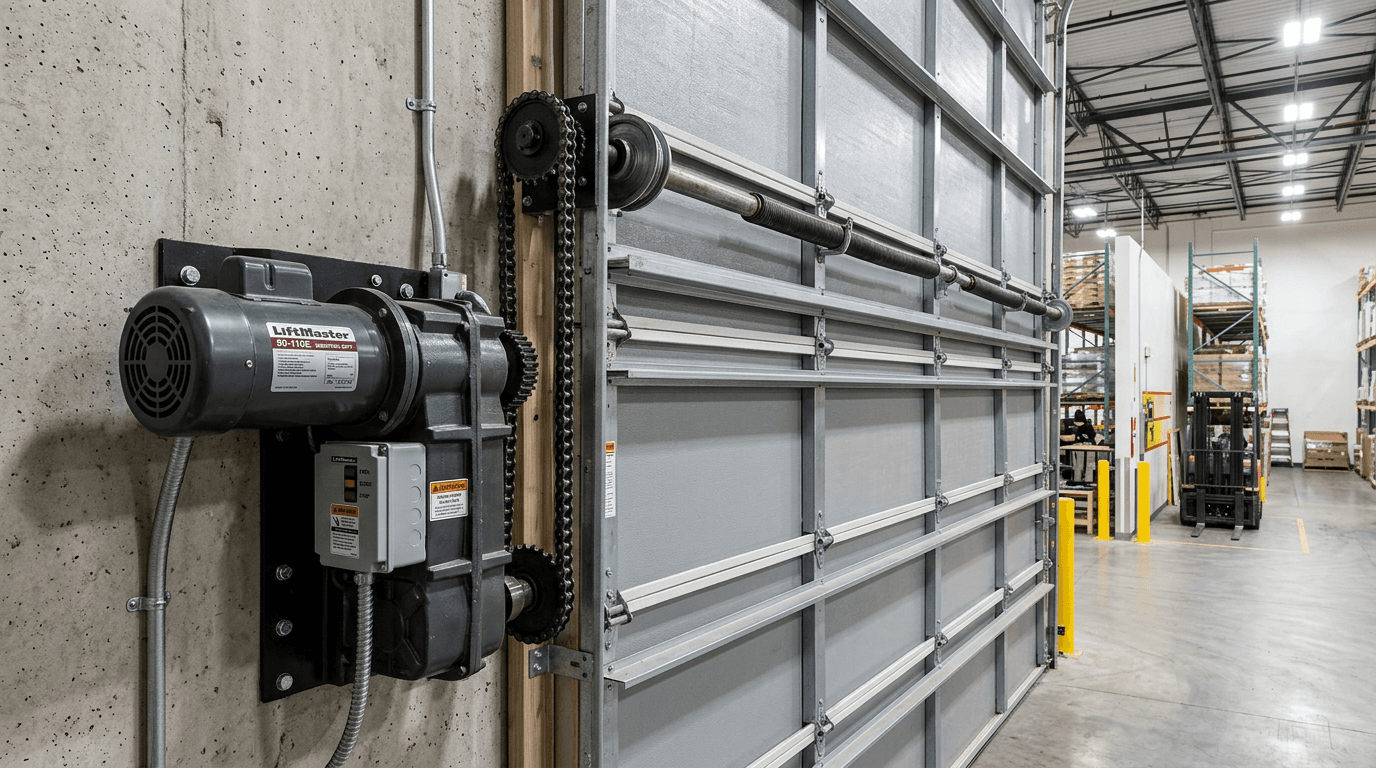
Choosing an industrial garage door opener isn't like picking a residential unit off the shelf. Commercial and industrial doors are heavier, cycle more often, face harsher conditions, and need to meet stricter safety and performance requirements. The wrong opener leads to premature motor failure, slow operation that bottlenecks your workflow, safety issues, and repair costs that dwarf the initial purchase price.
This guide covers everything you need to know to choose the right industrial opener for your facility.
Industrial vs. Residential Openers: Why It Matters
Residential garage door openers are designed for doors weighing 150-250 pounds that cycle 3-5 times per day. Industrial doors can weigh 500-3,000+ pounds and cycle 20-100+ times per day. Using a residential-grade opener on a commercial door—or even an undersized commercial unit—will burn out the motor quickly and create safety risks.
Key differences:
| Specification | Residential | Industrial |
|---|---|---|
| Door weight capacity | 150-300 lbs | 500-3,000+ lbs |
| Typical daily cycles | 3-5 | 20-100+ |
| Motor type | AC or DC, 1/2-1 HP | Three-phase, 1-3+ HP |
| Duty cycle | Light | Medium, heavy, or continuous |
| Safety systems | Basic auto-reverse | Entrapment protection, photo-eyes, timer-to-close, monitored safety circuits |
| Expected lifespan | 10-15 years | 15-25+ years with maintenance |
Types of Industrial Garage Door Openers
Jackshaft (Wall-Mount) Operators
Mounted on the wall beside the door, connected to the torsion spring shaft via a chain or belt drive.
How it works: The motor turns the torsion shaft, which winds or unwinds the springs and cables to open and close the door.
Best for:
- Standard sectional doors
- Doors with limited ceiling space (no overhead rail needed)
- Most common commercial/industrial application
Advantages:
- Doesn't require ceiling space or overhead structure
- Easy access for maintenance
- Works with existing torsion spring systems
- Available in a wide range of horsepower ratings
Considerations:
- Requires clear wall space next to the door
- Motor adds width to one side of the opening
Trolley (Ceiling-Mount) Operators
Mounted on the ceiling above the door, connected to the door via a trolley arm that rides along an overhead rail.
How it works: A motor drives a chain, belt, or screw that moves a trolley along a rail. The trolley connects to the door's top section and pushes/pulls it open and closed.
Best for:
- Light to medium commercial doors
- Applications where wall space is unavailable
- Doors with standard overhead clearance
Advantages:
- Keeps wall space clear
- Familiar operation (similar to residential but heavier duty)
- Good for lighter commercial applications
Considerations:
- Requires adequate ceiling structure to support the rail and motor
- Not ideal for very heavy doors (over 1,500 lbs)
- Rail limits headroom in the door opening area
Hoist Operators
Heavy-duty operators designed for the largest and heaviest industrial doors. Mounted on the wall, they use a chain or gear reduction system to lift the door.
How it works: A geared motor system provides high torque to lift extremely heavy doors at controlled speeds.
Best for:
- Heavy industrial sectional doors (1,500-3,000+ lbs)
- High-cycle applications (distribution centers, manufacturing)
- Doors requiring precise speed and position control
Advantages:
- Handles the heaviest doors
- Designed for extreme duty cycles
- Often includes advanced control features (variable speed, soft start/stop)
- Most durable option for demanding applications
Considerations:
- Highest cost
- Requires professional installation and setup
- Typically three-phase power required
Rolling Door Operators
Purpose-built for roll-up and coiling doors. Mounted directly on the door's barrel assembly.
How it works: The motor is integrated with or connected to the door's coiling barrel, directly rotating it to open and close the door curtain.
Best for:
- Roll-up steel doors
- Coiling doors and grilles
- Security shutters
- Any application using a rolling door type
Advantages:
- Compact—no external rail or separate mounting structure
- Designed specifically for rolling door mechanics
- Available with fire door release for fire-rated applications
Considerations:
- Not interchangeable with sectional door operators
- Motor access requires working at the door header
Key Specifications to Evaluate
Horsepower (HP) Rating
Motor power must match door weight and desired speed.
General guidelines:
| Door Weight | Recommended HP |
|---|---|
| Under 500 lbs | 1/2 - 3/4 HP |
| 500-1,000 lbs | 3/4 - 1 HP |
| 1,000-1,500 lbs | 1 - 1.5 HP |
| 1,500-2,500 lbs | 1.5 - 2 HP |
| Over 2,500 lbs | 2 - 3+ HP |
Important: These are guidelines, not rules. Door size, spring condition, track type, and desired speed all affect the actual HP required. An undersized motor running at capacity will overheat and fail early.
Duty Cycle
This defines how hard the opener can work before it needs to rest.
- Light duty: Up to 12 cycles per hour. Suitable for low-traffic openings.
- Medium duty: 12-25 cycles per hour. Standard for general commercial use.
- Heavy duty: 25-60 cycles per hour. For busy distribution and manufacturing.
- Continuous duty: Unlimited cycles. For the most demanding applications (high-speed doors, automated production lines).
Matching duty cycle to usage is critical. Running a light-duty operator in a heavy-duty application will burn out the motor within months. If you're unsure of your cycle count, err on the side of a higher duty rating.
Voltage and Phase
- Single-phase (115V or 230V): Suitable for lighter commercial applications. Available in most buildings.
- Three-phase (208V, 230V, or 460V): Required for heavy industrial operators. More efficient, produces more torque, and runs cooler. Requires three-phase electrical service, which most industrial facilities have but some smaller commercial buildings don't.
Verify your building's electrical service before specifying an opener. Adding three-phase power where it doesn't exist is a significant expense.
Speed
Standard industrial openers move doors at 6-12 inches per second. High-speed operators can achieve 24-100+ inches per second.
When speed matters:
- High-traffic openings where door cycle time creates workflow bottlenecks
- Climate-controlled facilities where faster closing reduces energy loss
- Security applications where rapid closing is needed
Speed trade-offs:
- Faster openers cost more and have more complex components
- Higher speeds require more sophisticated safety systems (higher risk of entrapment at speed)
- Not all door types can handle high-speed operation
Safety Features: Non-Negotiable for Commercial Use
Industrial door openers must include safety systems that protect workers from entrapment—being caught by a closing door. UL 325 sets the standard for commercial operator safety in the United States.
Required Safety Devices (UL 325)
Monitored photo-eyes:
- Infrared beam across the door opening detects objects in the door's path
- Must be monitored by the operator (operator knows if the sensor fails, not just if the beam is broken)
- Required for all automatically closing doors
Reversing edge (sensing edge):
- Pressure-sensitive strip on the door's bottom edge
- If the door contacts a person or object, it reverses immediately
- Some jurisdictions and applications require both photo-eyes and a sensing edge
Timer-to-close with warning:
- If the door automatically closes after a set time, an audible alarm and/or flashing light must warn for at least 5 seconds before closing begins
- Required for any door with automatic closing functionality
Emergency stop:
- Clearly marked, readily accessible button that stops door movement immediately
- Required on all commercial operators
Manual release:
- Allows the door to be disconnected from the operator and operated manually
- Essential for power outages, emergencies, and maintenance
- Must be accessible and clearly labeled
Additional Safety Considerations
- Soft start/stop: Gradually ramps motor speed up and down, reducing stress on the door system and the risk of sudden movement
- Slack cable detection: Stops the operator if a cable goes slack (indicates a cable break or obstruction)
- Overload protection: Shuts down the motor if resistance exceeds a set threshold
- Battery backup: Allows the door to be operated during power outages—critical for emergency egress and security
Top Industrial Opener Brands
Several manufacturers dominate the commercial/industrial opener market:
LiftMaster (Chamberlain Group):
- Widest range of commercial operators
- Strong dealer network and parts availability
- Models for every application from light commercial to heavy industrial
- Industry leader in smart/connected operator technology
Genie (Overhead Door Corporation):
- Reliable commercial and industrial operators
- Strong presence in the contractor/installer market
- Good mid-range options for general commercial use
- See our Genie commercial opener page
PowerMaster (MANARAS):
- Focused on heavy-duty and industrial applications
- Known for extreme durability and high-cycle performance
- Popular in distribution, manufacturing, and high-use environments
Raynor:
- Full line of commercial operators
- Paired well with Raynor door systems
- Good options for standard commercial applications
When choosing a brand, consider parts availability in your area, installer expertise, warranty terms, and compatibility with your existing doors. The best opener in the world doesn't help if nobody local can service it.
Choosing the Right Opener: Decision Framework
Work through these questions to narrow your options:
1. What type of door?
- Sectional → Jackshaft, trolley, or hoist operator
- Roll-up/coiling → Rolling door operator
- High-speed → Specialized high-speed operator
2. How heavy is the door?
- Weigh it or check manufacturer specs
- Choose an operator rated for at least 25% more than the door's weight
3. How many cycles per day?
- Track or estimate daily cycles
- Choose an operator with a duty cycle rating that exceeds your actual usage
4. What's your electrical service?
- Single-phase limits you to lighter operators
- Three-phase opens up the full range of industrial options
5. How important is speed?
- Standard speed is fine for most applications
- High-speed is worth the investment for high-traffic or climate-controlled openings
6. What safety features are required?
- At minimum: monitored photo-eyes, emergency stop, manual release
- High-traffic or public-adjacent doors: add sensing edge, timer-to-close with warning
7. Do you need smart/connected features?
- Remote monitoring and alerts
- Usage tracking and diagnostics
- Integration with building management systems
- Mobile app control
Installation Matters as Much as the Product
Even the best industrial opener will underperform or fail prematurely if installed incorrectly.
Why professional installation is essential:
- Proper sizing confirmation — An experienced installer verifies that the operator matches the door's weight, size, and usage
- Electrical work — Industrial operators often require dedicated circuits, three-phase wiring, or electrical panel modifications
- Spring system coordination — The opener and spring system must work together. Incorrect spring tension makes the opener work harder and shortens its life.
- Safety system setup — Photo-eyes, sensing edges, and limit switches must be properly positioned, calibrated, and tested
- Code compliance — Installation must meet local building codes, UL 325, and any industry-specific requirements
Maintaining Your Industrial Opener
An industrial opener is a significant investment. Protect it with regular maintenance:
- Monthly: Listen for unusual motor sounds, test safety devices, check for error codes
- Quarterly: Lubricate chain/belt, check tension, inspect wiring connections
- Annually: Professional inspection of motor, gears, limit switches, safety systems, and electrical connections
For a complete maintenance plan, see our commercial garage door maintenance checklist. If your opener is already showing issues, our opener troubleshooting guide covers the most common problems and fixes.
Get Expert Help Choosing Your Opener
Selecting the right industrial garage door opener involves balancing door specs, usage demands, electrical infrastructure, safety requirements, and budget. Getting it right means years of reliable service. Getting it wrong means premature failure and costly replacement.
Paratec's team installs and services industrial openers across Florida for warehouses, distribution centers, manufacturing plants, and commercial facilities of every type. We'll assess your doors, recommend the right operator, handle installation, and provide ongoing maintenance.
Explore our opener services:
Contact Paratec today for a free consultation on your industrial opener needs.