Hurricane-Resistant Garage Doors: What Florida Businesses Need to Know
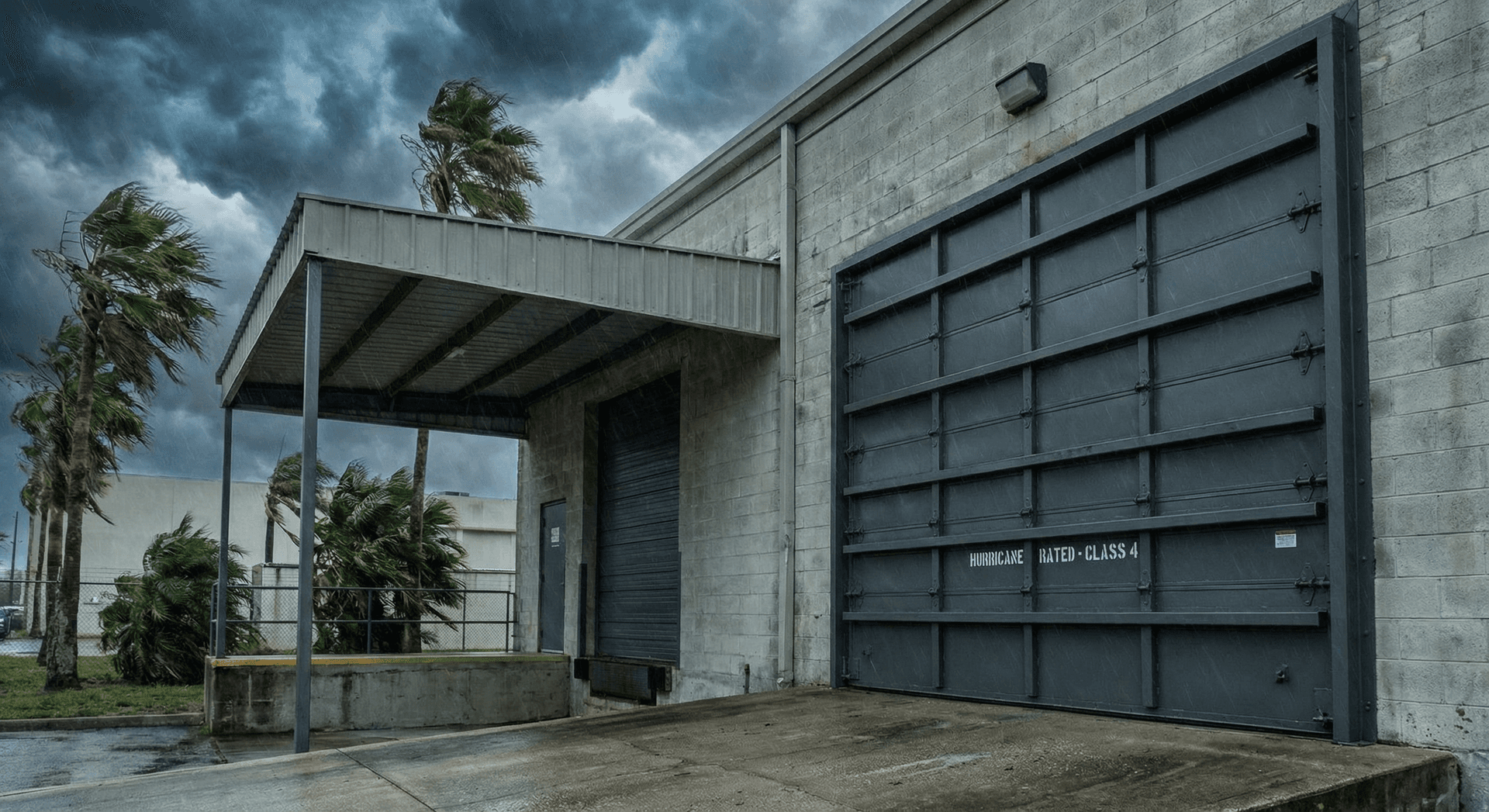
Florida businesses face a reality that most of the country doesn't: every year from June through November, hurricanes and tropical storms can strike with little warning. For commercial facilities, the garage door is often the largest opening in the building—and the most vulnerable point during a storm.
If your commercial garage door fails during a hurricane, the consequences go far beyond a broken door. Sudden pressurization can blow out walls, lift the roof, and cause catastrophic structural damage. Understanding hurricane-resistant door options isn't optional for Florida businesses—it's a matter of protecting your people, your inventory, and your livelihood.
Why Garage Doors Are the Weak Link in a Storm
During a hurricane, wind doesn't just push against a building—it finds openings. A standard commercial garage door can buckle under wind loads as low as 90 mph. Once breached, wind enters the structure and creates internal pressure that pushes outward on walls and upward on the roof.
The chain of events:
- Wind pressure exceeds the door's rating
- Door panels buckle, flex, or blow inward
- Internal pressure spikes instantly
- Roof uplift forces increase dramatically
- Walls, windows, and roof can fail in seconds
This is why Florida's building code puts specific requirements on large openings like garage doors—they're not just doors, they're part of your building's structural envelope.
Florida Building Code Requirements
The Florida Building Code (FBC) is one of the strictest in the country for wind resistance. If your commercial building is in a designated Wind-Borne Debris Region (WBDR)—which covers most of South Florida and coastal areas—your garage doors must meet specific impact and pressure ratings.
Key requirements:
- Wind pressure rating — Doors must withstand the design wind speed for your location. This ranges from 120 mph inland to 180+ mph in coastal South Florida.
- Impact resistance (missile testing) — In WBDR zones, doors must pass large missile impact testing: a 9-pound 2x4 fired at the door at 50 fps. This simulates flying debris during a hurricane.
- Cycling after impact — After being struck by debris, the door must still resist wind pressure through positive and negative pressure cycling.
- Product approval — All hurricane-rated doors must carry a Florida Product Approval (NOA or FL number) documenting their tested performance.
Important: Even if your area wasn't historically in a high-wind zone, FBC updates have expanded requirements. When replacing or installing new doors, you must meet current code—not the code from when your building was originally constructed.
Types of Hurricane-Resistant Commercial Garage Doors
Not all hurricane-rated doors are the same. The right choice depends on your facility type, opening size, usage frequency, and budget.
Wind-Load Rated Sectional Doors
Standard sectional garage doors reinforced with internal bracing, thicker gauge steel, and heavier-duty hardware.
- Best for: Warehouses, distribution centers, general commercial
- Wind ratings: Typically 120-170 mph depending on model and bracing
- Pros: Familiar operation, good insulation options, wide size range
- Cons: Requires reinforcement for highest wind zones, heavier than standard doors
Impact-Rated Roll-Up Doors
Rolling steel or aluminum doors engineered to pass both wind pressure and missile impact testing.
- Best for: High-wind coastal areas, storefronts, any WBDR location
- Wind ratings: Up to 180+ mph with impact certification
- Pros: Compact footprint, no overhead track space needed, excellent for high-wind zones
- Cons: Higher cost than standard roll-ups, limited insulation options
Hurricane-Rated High-Speed Doors
Rapid-cycling doors designed for high-traffic openings that also meet hurricane wind and impact requirements.
- Best for: Distribution centers, manufacturing, any facility with frequent door cycles
- Wind ratings: Varies by model, up to 160+ mph
- Pros: Reduces open time (less wind exposure), energy efficiency, high cycle count
- Cons: Higher upfront cost, more complex maintenance
Storm Panels and Shutter Systems
Removable or deployable panel systems that mount over existing door openings before a storm.
- Best for: Facilities that want to keep existing doors and add storm protection
- Wind ratings: Up to 180+ mph depending on system
- Pros: Lower cost than full door replacement, can protect any opening
- Cons: Requires deployment time, storage space, labor to install before each storm
For more on our hurricane garage door options, visit our dedicated service page.
Understanding Wind Ratings and What They Mean
Wind ratings can be confusing. Here's what matters:
Design pressure (DP) rating measures the door's ability to withstand wind pressure in pounds per square foot (psf). Higher DP means more wind resistance. Your engineer or local building department determines the required DP based on:
- Building location and exposure category
- Door opening size (larger openings need higher ratings)
- Building height
- Terrain and surrounding structures
Wind speed rating is what most people reference. Common requirements by Florida region:
- Inland Central Florida: 120-140 mph
- Tampa Bay/Gulf Coast: 140-160 mph
- East Coast (Palm Beach to Jacksonville): 140-170 mph
- South Florida/Miami-Dade: 170-185+ mph
- Florida Keys: 180+ mph
Miami-Dade County NOA is the gold standard. If a door has a Miami-Dade Notice of Acceptance, it meets the most stringent impact and wind requirements in the state.
Insurance Benefits of Hurricane-Resistant Doors
Upgrading to hurricane-rated doors can significantly reduce your commercial property insurance premiums. Florida insurers offer wind mitigation credits for buildings with properly rated opening protections.
Potential savings:
- 5-15% reduction in wind coverage premiums
- Some insurers offer larger discounts for Miami-Dade approved products
- Additional credits when combined with other mitigation features (roof, shutters)
- Lower deductibles in some cases
To claim these credits:
- Have a licensed inspector complete a Wind Mitigation Inspection (Form OIR-B1-1802)
- Ensure your doors have current Florida Product Approval documentation
- Provide proof of installation by a licensed contractor
- Submit documentation to your insurance carrier
The premium savings often pay for the door upgrade within 3-5 years, making it a smart financial decision even without considering storm protection.
When to Replace vs. Retrofit
If your current commercial doors don't meet hurricane ratings, you have two options:
Retrofit (Reinforcement)
- Add internal bracing and wind bars to existing sectional doors
- Upgrade track systems and mounting hardware
- Install heavier-duty springs and cables
- Add storm panel systems over existing openings
Best when: Doors are in good condition, budget is limited, or the building is in a lower wind zone where bracing can achieve required ratings.
Full Replacement
- Install new hurricane-rated doors purpose-built for your wind zone
- Ensure full code compliance with current FBC requirements
- Get proper product approval documentation for insurance credits
Best when: Doors are aging or damaged, you're in a high-wind zone (150+ mph), you want maximum insurance credits, or you're renovating the facility.
Our team can assess your current doors and recommend the most cost-effective path to compliance. Contact us for a wind assessment.
Common Mistakes Florida Businesses Make
Assuming existing doors are rated. Many commercial buildings have doors that met code when installed but don't meet current requirements. Code updates in 2002, 2007, 2010, 2017, and 2020 all tightened wind requirements.
Waiting until hurricane season. Door manufacturers and installers are swamped from June through November. Lead times for hurricane-rated doors can stretch to 8-12 weeks during season. Plan your upgrades during the off-season (December through April).
Ignoring maintenance. A hurricane-rated door that hasn't been maintained loses its effectiveness. Corroded hardware, worn springs, and damaged seals all compromise wind resistance. Include your hurricane doors in your maintenance program.
Not keeping documentation. Product approval numbers, installation certificates, and wind mitigation inspection reports are essential for insurance claims. Keep copies on-site and digitally.
Only protecting some openings. Wind pressure doesn't discriminate. If you upgrade your main bay doors but leave a side door unprotected, that's where the failure will happen.
Preparing Your Doors Before a Storm
Even with hurricane-rated doors, preparation matters:
- Inspect all doors — Check for damage, loose hardware, or worn components at the start of hurricane season
- Test operation — Make sure every door opens and closes smoothly
- Secure loose items — Clear the area around doors of anything that could become a projectile
- Close and lock all doors — Engage all locking mechanisms before the storm arrives
- Disconnect openers — Power surges during storms can damage opener electronics; disconnect power
- Deploy storm panels if applicable
- Document condition — Take photos/video of all doors before the storm for insurance purposes
Take Action Before the Next Storm
Florida's hurricane risk isn't going away—if anything, climate trends suggest stronger storms are ahead. The time to assess and upgrade your commercial garage doors is now, not when a storm is bearing down.
Paratec provides:
- Free wind vulnerability assessments for commercial facilities
- Hurricane-rated door supply and installation across Florida
- Retrofit and reinforcement for existing doors
- Ongoing maintenance to keep rated doors performing at spec
- Emergency repair and board-up services during storm season
Don't wait for the next hurricane warning. Contact Paratec today to schedule a wind assessment and learn which hurricane-resistant door solution is right for your business.